
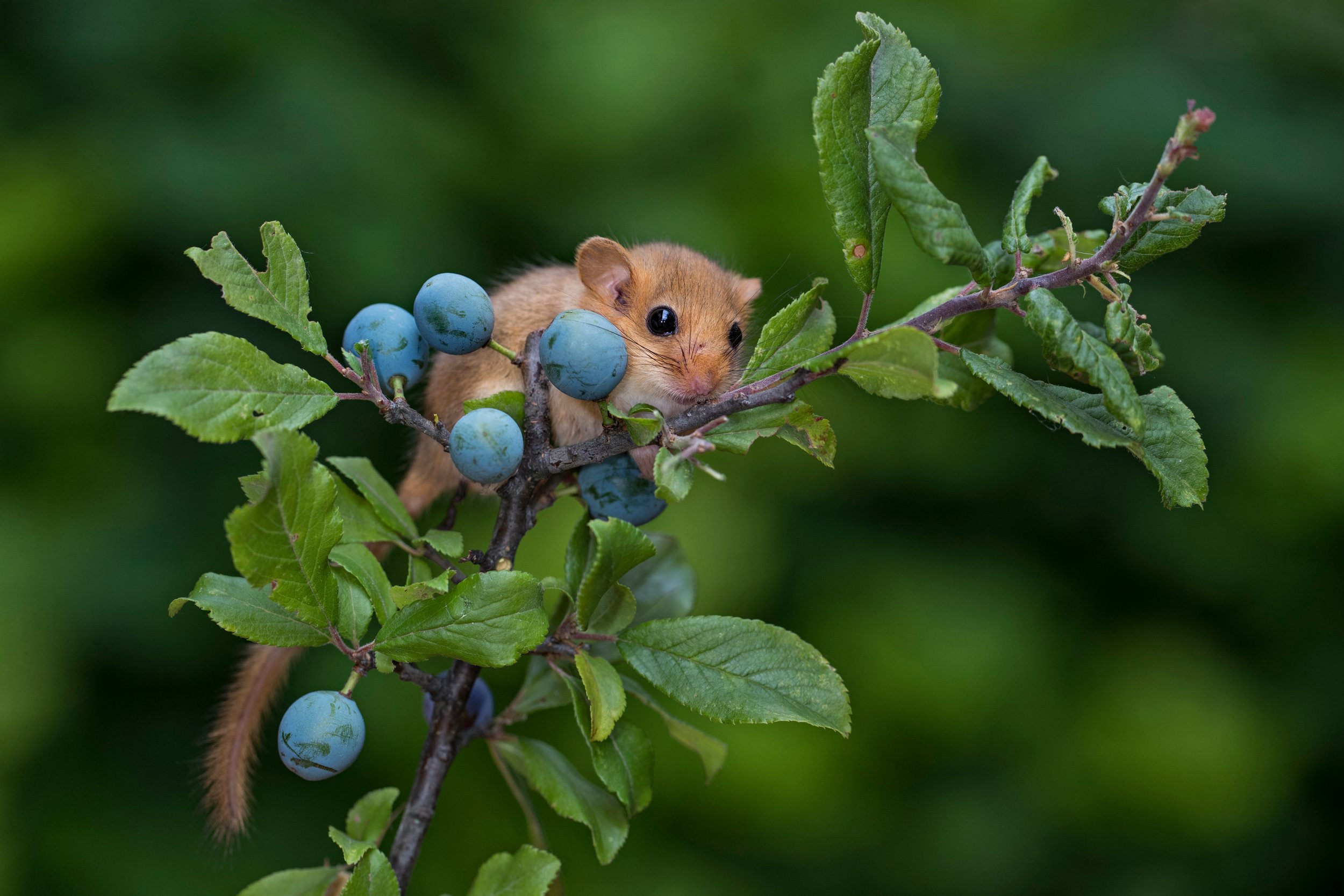
Hazel Dormouse
Hazel Dormouse
Muscardinus avellanarius
Hazel dormice are a small, nocturnal rodent native to the UK, valued for their delicate appearance and secretive habits. Recognisable by their golden-brown fur, large black eyes and a bushy tail, they are arboreal and rely on well-connected hedgerows and woodland understorey to feed, nest and move safely. Primarily feeding on flowers, fruits, nuts and insects, dormice hibernate through the winter in nests close to the ground or in leaf litter, and are particularly sensitive to habitat fragmentation and loss, making them a priority species for conservation and habitat management.
The hazel dormouse (Muscardinus avellanarius) is a declining, nocturnal small mammal native to the UK, typically associated with broadleaved woodland, coppice, scrub, hedgerows and species-rich parkland where dense structural connectivity allows movement and nesting; populations are most secure in parts of southern England but fragmented and scarce elsewhere, particularly where habitat continuity and understorey complexity have been lost.
Arboreal and largely herbivorous, dormice feed on flowers, nectar, pollen, berries, seeds and insects, showing seasonal shifts in diet and a strong reliance on diverse shrub and tree species for food and nest sites; they hibernate for long periods in winter in ground-level nests, emerging in spring to reproduce and occupy leaf or woven nests in dense vegetation.
A dormouse survey may be required for development or land‑use change because the species and its nests are protected under UK law; identifying presence, nest locations and habitat connectivity is essential to inform mitigation, translocation or retention measures, licensing and timing of works to avoid legal offence and minimise impacts on this vulnerable species.

When might I need a Dormouse Survey?
A dormouse survey is needed when planned works could disturb hazel dormice, their nests or habitat, which commonly includes any development or land‑use change affecting broadleaf woodland, coppice, scrub, hedgerows, species‑rich hedgerow margins, or dense understory vegetation; activities that involve removal or substantial trimming of hedgerows, woodland clearance, tree felling, groundworks, drainage changes or construction within or adjacent to such habitats; and where planning authorities, ecological consultants or local records indicate past records or suitable habitat on or near a site.
Under UK law the dormouse (Muscardinus avellanarius) is protected by the Wildlife and Countryside Act 1981 (as amended) and the Habitats Regulations, making it an offence to deliberately capture, kill, injure or disturb dormice or to damage or destroy their places of shelter, so surveys are required early in the project lifecycle - typically during a preliminary ecological appraisal or before any clearance or groundworks - to establish presence, distribution and nesting locations and to identify whether mitigation, timing restrictions, or a European Protected Species mitigation licence from the relevant statutory body will be necessary.
Explore other protected species
Learn about other protected species including bats, birds, reptiles and more.